
Far More Than Just Sustainable Building Materials
The demand for environmentally responsible products continues to shape design and construction decisions, and natural stone is emerging as a leading choice for sustainability. Many still overlook its full potential as a durable, low-impact material. To support this, the industry developed the ANSI/NSI 373 sustainability certification, a third-party verified program that ensures best practices in quarrying and fabrication. Today, decision-makers can look for stone certified under this standard as a trusted indicator of sustainable production, opening up endless possibilities for eco-conscious projects. Designers are pushing creative boundaries, finding innovative ways to integrate this timeless material into sustainable designs.
Below are examples of striking projects that showcase how natural stone can elevate environmentally friendly design.
New Life in Natural Stone Remnants
One of the most widely known principles of environmental stewardship is that of eliminating waste by using every part of the material. This means finding a use for everything that is extracted or quarried, even post-production remnants from fabrication. Environmentally responsible designers find creative ways to incorporate odds and ends into new designs.
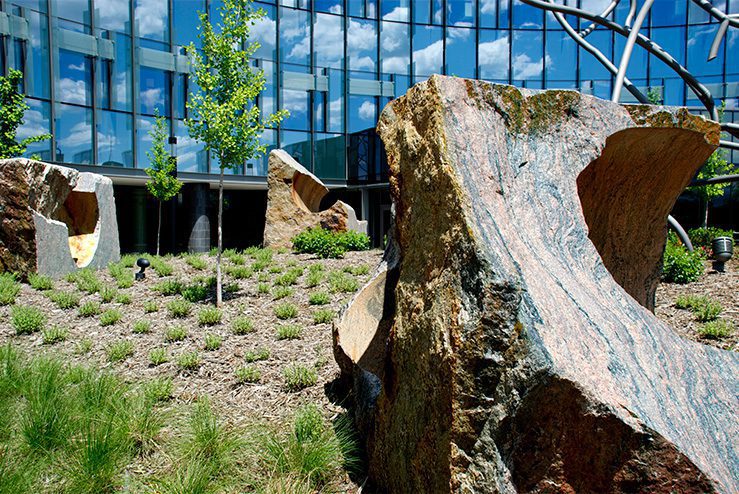
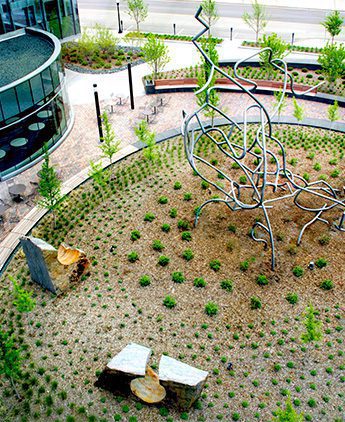 In a creative twist on repurposing, remnant pieces of stone from a quarry became sculptural elements in a landscape design at the University of Minnesota. The landscape designer was tasked with creating a space outside the University’s new Cancer and Cardiovascular Research Building. After visiting the stone fabricator’s facility, the designer hand selected uniquely shaped remnants from a recent fabrication.The resulting design, named Adjacent Possible, incorporates three massive blocks of Rainbow® granite and a stainless steel pipe design that defines the space above the plaza in an open-ended dance. Rainbow granite also appears in the form of pavers surrounding the sculptural elements.
According to the landscape designer, the work’s title comes from a term in the book Investigations by the theoretical biologist Stuart Kauffman. Kauffman postulates that life and environment co-construct the biosphere by continually moving into what he calls the adjacent possible—the new that is most possible given current conditions.
Sculptural Significance
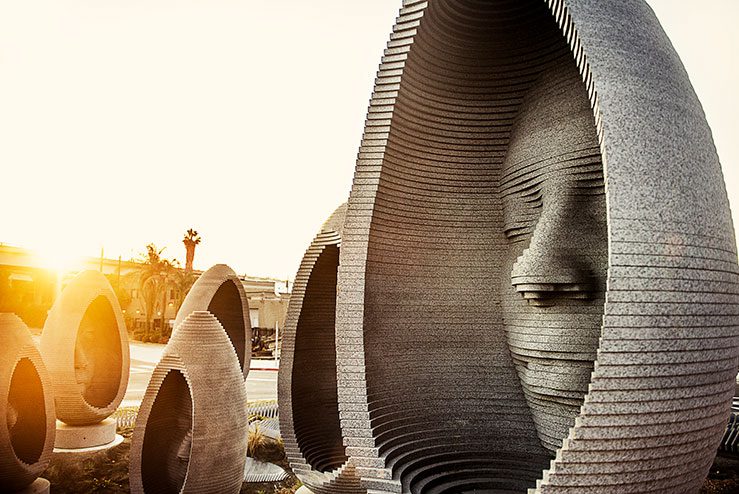
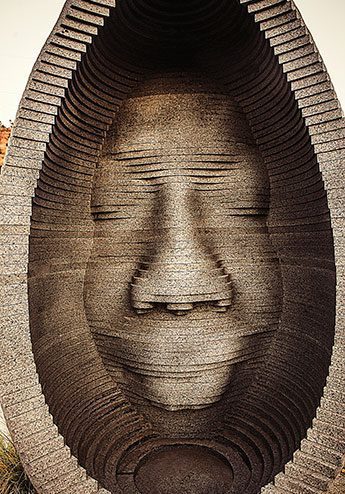
Across the country in Los Angeles, CA, the Riverside Roundabout incorporates natural stone into a creative design to help control the impacts of smog and storm water runoff. The roundabout’s centerpiece provides an artistic experience through nine egg-shaped stone sculptures constructed of Academy Black® granite locally sourced from a quarry in California. Measuring eight to twelve feet tall, the sculptures feature randomly chosen faces of individuals from the community. The granite supplier selected and cut the slabs with CNC cutting equipment to provide full utilization of the slab.
 Bridging the Gap Between Function & Fashion
The roundabout also serves as a stormwater bioretention landscape with the capacity to capture and treat a 10-year rainfall event (500,000 gallons) from an adjacent bridge and roadways. The system also includes a 25,000 gallon cistern supplying a water feature as well as a solar tracking photovoltaic system powering irrigation, lighting, and the artwork. A 100% sustainable project, the Riverside Roundabout was designed with full utilization of the granite slabs being used to create the eggs, with the remaining parts of the slab creating a stone border around the roundabout. Natural stone projects in the future will incorporate creativity and sustainability in their designs as more and more decision makers realize the full possibilities of natural stone. Like the landscape at the University of Minnesota, perhaps we can all create a new biosphere by moving into the adjacent possible space—combining creativity with environmentally responsible designs.
For more information about how natural stone helps meet sustainability goals, contact your Regional Sales Manager.