Coldspring
Revitalizing a National Icon: The Smithsonian National Air and Space Museum
Even the most iconic buildings eventually need renewal. After decades of inspiring millions of visitors with its cutting-edge exhibitions and historic artifacts, the Smithsonian National Air and Space Museum in Washington, D.C. underwent one of the most ambitious revitalization projects in the Smithsonian Institution’s history.
Opened in 1976, the museum’s original façade was clad in thin Tennessee Pink marble. Over time, decades of weather expose, thermal cycling, and pollution led to bowing, cracking, and detachment of the panels. By 2017, the deterioration had become severe enough to require a full exterior replacement, an undertaking that would preserve the museum’s architectural legacy while bringing it into the modern era of performance and sustainability.
Reimagining a Classic
The Smithsonian sought a solution that would replicate the museum’s timeless aesthetic while vastly improving its durability. Quinn Evans Architects led the design for the nearly $1 billion revitalization, emphasizing both long-term durability and fidelity to the museum’s original aesthetic.
Engineering for the Next Century
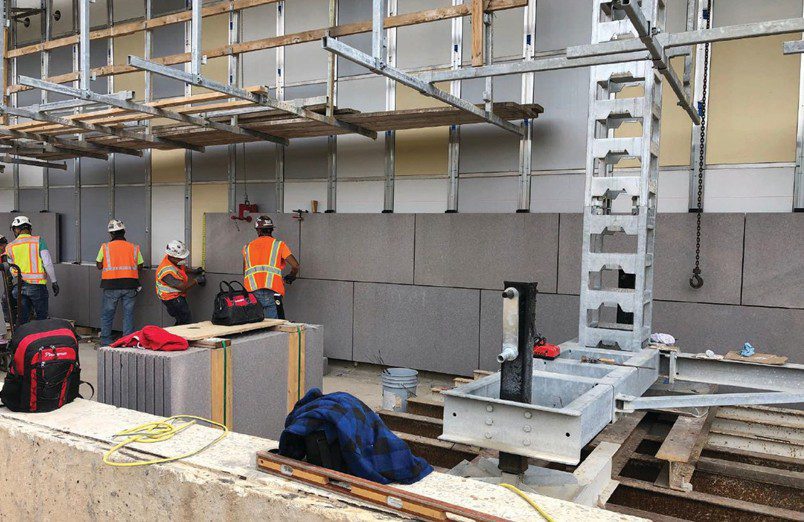
Coldspring fabricated more than 160,000 square feet of 2-inch-thick Rub & Sand Colonial Rose granite panels for the project. Each piece was precisely cut to meet the design’s tight tolerances, ensuring seamless alignment during installation. These panels were installed over a new thermally broken aluminum rainscreen system that accommodates building movement and improves insulation and water management. The modern assembly represents a significant leap forward in building envelop performance, engineered for a service life exceeding 100 years.
Rugo Stone, in partnership with Clark-Smoot-Consigli (a joint venture between Clark Construction Group, Smoot Construction Company, and Consigli Construction Company), managed the installation. Because the museum remained partially open throughout the multi-year renovation, safety, logistics, and sequencing were crucial. Each panel was set with meticulous attention to alignment, following a detailed plan that balanced preservation of public access with construction efficiency.
Collaboration and Craftsmanship
Executing a project of this scale required close coordination among numerous partners. Coldspring’s fabrication team collaborated extensively in providing finish, veining, and dimensional accuracy across thousands of granite panels. The company’s state-of-the-art quarrying and fabrication operations provided the capability to meet the Smithsonian’s stringent performance and appearance standards.
A Tribute to Innovation
The revitalized façade strikes a thoughtful balance between historic preservation and contemporary design innovation. The Colonial Rose granite retains the warm, inviting color that visitors have associated with the museum for nearly 50 years, yet behind that familiar face lies a sophisticated wall system that dramatically improves energy efficiency, moisture resistance, and long-term durability.
By supplying a natural stone solution that meets today’s structural and environmental standards, Coldspring played a vital role in extending the museum’s service life while celebrating its architectural and cultural significance. The updated exterior is more than just a protective envelope, it is a reflection of the museum’s enduring mission of exploration, science, and innovation.
The Smithsonian National Air and Space Museum’s transformation ensures that this national treasure will continue to inspire awe and wonder for generations to come. Through careful craftsmanship, collaboration, and respect for design heritage, Coldspring helped preserve a building that tells the story of humanity’s pursuit of flight, and of progress itself.

To discover more about the kinds of creations Coldspring has made with our materials, reach out to us today.